Start with an oddly precise number: thirteen degrees and twenty minutes. It's the key to what may be the oldest personality system still in daily use anywhere.
The Moon circles the Earth in about 27.3 days measured against the fixed stars, one sidereal month. Divide the 360-degree zodiac by 27 and you get 13°20', roughly the distance the Moon covers in a day and a night. Ancient Indian astronomers marked each of those daily stations with a prominent star or cluster, and gave every station a name, a symbol, a presiding deity, and a temperament. These are the Nakshatras (Sanskrit: नक्षत्र), the 27 lunar mansions of Jyotish. By Vedic reckoning, the one the Moon occupied when you were born is the most personal placement in your whole chart.
If your Western chart has always felt like a suit that fits at the shoulders but not the wrists, accurate in broad strokes and vague on the details, the Nakshatra is usually the missing detail.
Finding yours, and reading the result
You need three things: your birth date, your birth time as precisely as possible, and your birthplace. The place sets the time zone, and the time sets where the Moon was. The Moon moves about half a degree an hour, roughly one degree every two hours, so even a modest error in the time can shift the result.
One caution before you look anything up. Jyotish uses the sidereal zodiac, which currently sits roughly 24 degrees behind the Western tropical zodiac. You can't match the Moon position printed on a Western chart against the ranges below: a Western "15° Gemini Moon" is a Vedic Moon in late Taurus. Use a calculation done in the sidereal framework, or expect your placements to shift by nearly a sign.
The result comes in three levels, from coarse to fine:
- Moon sign (rashi): which of the 12 signs of 30° the Moon was in.
- Nakshatra: which of the 27 mansions of 13°20' it was in. A nakshatra can run across two signs, so the Moon sign alone doesn't tell you the nakshatra.
- Pada: which quarter of the nakshatra, 3°20' each. There are 108 padas, nine to a sign, so a pada never crosses a sign boundary.
The nakshatra fixes its ruler, and how far the Moon had travelled into the nakshatra sets the dasha balance described further down.
A worked example. Take a sample birth on 13 May 1994 at 09:00 in New Delhi. Calculated with the Lahiri ayanamsa, the sidereal Moon is at 55.10° of the zodiac:
- Moon sign: Taurus, at 25°06' (55.10° minus the 30° of Aries)
- Nakshatra: Mrigashira, which runs from 23°20' Taurus to 6°40' Gemini. The Moon is 1°46' into it.
- Pada: 1, because 1°46' is inside the first 3°20'
- Ruler: Mars, so the dasha sequence opens with Mars. About 6.1 of Mars's 7 years remain, running to June 2000, and Rahu's 18 years follow.
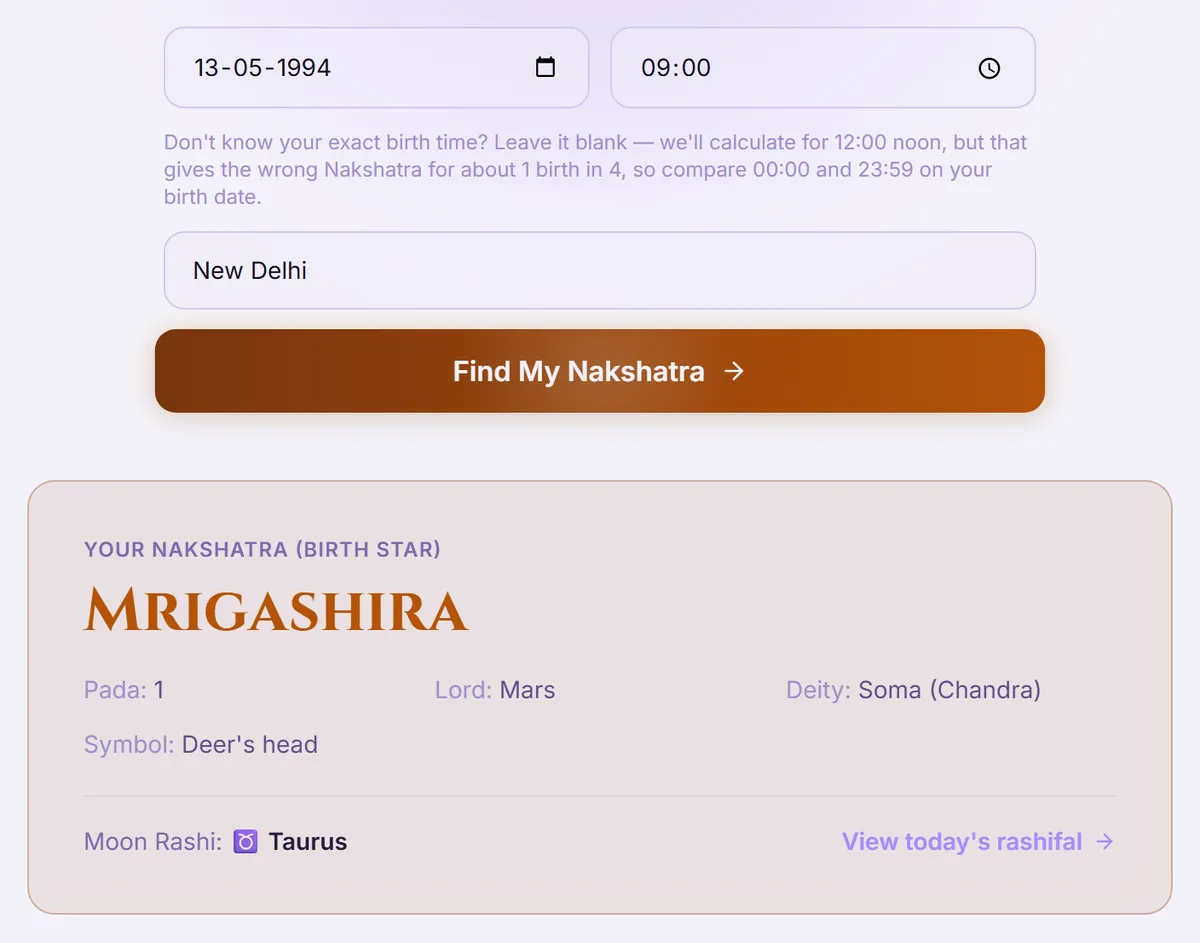
AstroMystra's Nakshatra calculator gives the nakshatra, pada, ruler and Moon sign from the same three inputs. It doesn't print the Moon's degree. The Kundli tab of the birth chart in your account lists each planet's degree within its sign as a decimal (25.10° for this Moon), which you can place in the ranges below.
Why the birth time matters. On the same day in New Delhi, the Moon left Rohini for Mrigashira at 05:30, moves into pada 2 at 12:07, and enters Gemini at 18:43. After 18:43 the Moon sign is Gemini while the nakshatra is still Mrigashira, now in pada 3. If a birth time sits near a change like these, check it before reading much into the result. Why a Nakshatra Calculator Can Change Near a Boundary covers what to look at.
Older than the zodiac you know
Most people assume the 12-sign zodiac is the ancient system and everything else came later. In India it's the other way around. Nakshatras appear by name in the Atharvaveda and the Taittiriya Samhita, Vedic texts compiled well over two and a half thousand years ago, where they were used to time rituals, name newborns, and fix auspicious days. The 12 signs (rashis) entered Indian astrology later, through contact with Hellenistic astronomy.
So a Jyotish astrologer reading your Moon Nakshatra isn't adding decimal places to the Western system. They're using the older map, drawn around the Moon's monthly journey rather than the Sun's yearly one. The word Nakshatra is often glossed as "that which does not decay," meaning the fixed stars, the part of the sky that holds still while everything else wheels past.
That difference in starting point shapes the whole system. Sun-based astrology describes the self that acts in the world: visible, directed, seasonal. Moon-based astrology describes the self that experiences the world: the mind, the instincts, the emotional weather. Jyotish treats the second as primary, which is why in much of India, when someone asks your "sign," they traditionally mean your Moon sign, and beneath that your Nakshatra.
Nine rulers, twenty-seven mansions
Every Nakshatra belongs to one of the nine planets of Jyotish: the seven classical bodies plus Rahu and Ketu, the lunar nodes. Each planet rules exactly three mansions, and those three sit 120 degrees apart, in trine to one another around the wheel. This ninefold grouping is the system's underlying structure, so it's easiest to meet the 27 through their rulers rather than in a flat list.
The keywords below are the tradition's associations, as teachers commonly summarise them, not traits measured in people.
Ketu's three, the uprooters. Ashwini (0° to 13°20' Aries; symbol: horse's head) is swift initiation and the healer's instinct; its presiding deities, the Ashwins, were divine physicians. Magha (0° to 13°20' Leo; throne room) carries ancestral authority, the weight and dignity of lineage. Mula (0° to 13°20' Sagittarius; bundle of roots) tears up whatever is false at the root, destructive only in the service of truth. All three open a fire sign, so Ketu's mansions sit at raw beginnings.
Venus's three, the enjoyers. Bharani (13°20' to 26°40' Aries; yoni) holds the gate between birth and death, and is read as intense, creative and unafraid. Purva Phalguni (13°20' to 26°40' Leo; hammock) is rest, romance, and the arts of pleasure. Purva Ashadha (13°20' to 26°40' Sagittarius; fan or elephant's tusk) is called the invincible one, idealism that refuses to yield once committed.
The Sun's three, the finishers. Krittika (26°40' Aries to 10° Taurus; flame or blade) cuts away impurity with razor decisiveness. Uttara Phalguni (26°40' Leo to 10° Virgo; cot or bed) builds the stable foundations that let others flourish. Uttara Ashadha (26°40' Sagittarius to 10° Capricorn; elephant tusk) is final, unstoppable victory through righteous effort, the one who completes what others abandon.
The Moon's three, the sustainers. Rohini (10° to 23°20' Taurus; chariot) lies in Taurus, the Moon's sign of exaltation, and is traditionally called the Moon's favourite mansion: abundant, sensual, creative, and often described as the most beautiful of all 27. Hasta (10° to 23°20' Virgo; open hand) gives skill, dexterity, and a healing touch, literal and figurative. Shravana (10° to 23°20' Capricorn; ear) is sacred listening, wisdom absorbed through attention rather than argument.
Mars's three, the makers. Mrigashira (23°20' Taurus to 6°40' Gemini; deer's head) is the eternal seeker, gentle, curious and restless. Chitra (23°20' Virgo to 6°40' Libra; bright jewel) is the celestial architect, gifted in design, form, and aesthetics. Dhanishtha (23°20' Capricorn to 6°40' Aquarius; drum) is rhythm, timing, music, and the patient building of wealth.
Rahu's three, the outsiders. Ardra (6°40' to 20° Gemini; teardrop) is the storm that breaks things open so renewal can follow. Swati (6°40' to 20° Libra; young shoot swaying in wind) bends without breaking: independent, diplomatic, self-made. Shatabhisha (6°40' to 20° Aquarius; empty circle, "the hundred healers") heals through solitude, research, and unconventional knowledge.
Jupiter's three, the believers. Punarvasu (20° Gemini to 3°20' Cancer; bow and quiver) means "the return of the light," restoration and renewed optimism after hardship. Vishakha (20° Libra to 3°20' Scorpio; triumphal arch) is single-minded pursuit of a distant goal through every obstacle. Purva Bhadrapada (20° Aquarius to 3°20' Pisces; funeral pyre, two-faced man) is radical spiritual transformation, the burning of what is finished.
Saturn's three, the devoted. Pushya (3°20' to 16°40' Cancer; flower, cow's udder) is widely held to be the most auspicious of all the Nakshatras: quiet, nourishing, endlessly reliable. Anuradha (3°20' to 16°40' Scorpio; lotus) is loyalty that survives hardship, love that grows in mud. Uttara Bhadrapada (3°20' to 16°40' Pisces; back legs of a funeral cot) is the deep calm of the seasoned teacher, wisdom earned through experience.
Mercury's three, the perceivers. Ashlesha (16°40' to 30° Cancer; coiled serpent) sees beneath every surface and is read as penetrating, intuitive and nearly impossible to deceive. Jyeshtha (16°40' to 30° Scorpio; earring or amulet) is "the eldest," a protective authority that carries the weight of others. Revati (16°40' to 30° Pisces; fish) closes the circle gently, as the guide who shepherds the lost across thresholds, ending the zodiac without bitterness so it can begin again.
Read the groups a second time and you'll see each planet stamps a shared signature on its three mansions. Ketu's all uproot, Saturn's all endure, Mercury's all perceive. The 27 are nine planetary themes, each expressed three ways around the wheel.
The clock hidden in your chart
Western astrology has no real equivalent for this part. In Jyotish, your Moon Nakshatra also sets the starting point of your life's planetary timetable.
The best-known predictive tool in Jyotish, the Vimshottari Dasha, divides an idealised 120-year lifespan among the nine planets in a fixed order: Ketu 7 years, Venus 20, Sun 6, Moon 10, Mars 7, Rahu 18, Jupiter 16, Saturn 19, Mercury 17. Which planetary chapter your life opens in, and so the whole sequence that follows, depends on exactly one thing: the ruler of your Moon Nakshatra, and how far through that mansion the Moon had travelled when you were born.
Born with the Moon in Rohini? Your life begins in a Moon period. Born in Ardra? You start under Rahu, eighteen years of it minus however much the Moon had already used up. Two babies born the same week, one with the Moon at the end of Ashlesha and one at the start of Magha, begin life on entirely different planetary clocks. In the Vedic view, that's why siblings raised identically can live such differently timed lives.
No Western technique hangs this much on the Moon's exact degree. In Jyotish the Nakshatra drives the chart's timing, which is a long way from being a decorative extra.
Where you've already met them
If you grew up in or around Indian culture, the Nakshatras have been running in the background of your life whether or not you knew their names.
Open any panchang, the traditional Hindu almanac, and the day's Nakshatra is listed beside the date, because the Moon's current mansion is one of the five limbs of the Vedic calendar. When families consult an astrologer for a muhurta (an auspicious time for a wedding, a housewarming, or opening a business), the Nakshatra the Moon will occupy is one of the first things checked. Pushya is prized for almost everything except marriage, while certain days are avoided for beginnings altogether.
Traditional baby naming runs through the Nakshatras too. Each mansion is divided into four quarters (padas), and each quarter has a prescribed opening syllable. That's why a priest, told a child's birth details, can say the name "should begin with So" or "should begin with Chu." The custom builds the child's Moon Nakshatra into the name they answer to every day.
In marriage matching, the well-known Ashtakoota or "36 gunas" system that families still use to compare horoscopes is computed almost entirely from the two partners' Moon Nakshatras. Their Sun signs barely feature. Timing decisions, naming customs and compatibility lore across a whole civilisation all run on the 27 mansions.
One Moon sign, three different people
Take three people born with the Moon in Taurus, the same steady, sensual Moon sign in any Western reading.
The first was born with the Moon at 5° Taurus. That's Krittika, ruled by the Sun and symbolised by a blade. The tradition reads this Moon as sharp-tongued and exacting, the friend who tells you the truth you didn't ask for.
The second, at 15° Taurus, has a Rohini Moon, the Moon's traditional favourite, in its sign of exaltation. Teachers describe this Moon as artistic, unhurried and quietly magnetic, someone that things and people seem to gather around without visible effort.
The third, at 28° Taurus, has a Mrigashira Moon, ruled by Mars and symbolised by a searching deer. The tradition pictures this Moon as gentle but restless, always mid-course, mid-book or mid-move, chasing something just out of frame.
One Moon sign can hold three nakshatras with three different traditional portraits. That's the extra detail the 13°20' division gives a Jyotish reading. It doesn't show that the three people's inner lives actually differ that much.
The part of the sky that doesn't decay
The astronomers who named the Nakshatras watched the Moon return, night after night, to stars that never moved. They had no telescopes or ephemeris software, only patience, dark skies, and a few thousand years of continuous attention. The system they built rests on that idea: beneath the changing weather of a life, there's a fixed patch of sky the Moon was crossing when you were born.
Sources & References
Astronomical data: Sidereal Moon positions across AstroMystra are calculated using the astronomy-engine ephemeris library with the Lahiri (Chitrapaksha) ayanamsa. See our Methodology for full technical detail.
Astrological tradition: The interpretations above draw on the sources named under Classical references below. Where an interpretation is not tied to a named source, it is AstroMystra's paraphrase of common practice among teachers of the tradition, not a verified rule of prediction. AstroMystra's specific phrasing, examples, and emphasis are its own.
Classical references: The Nakshatra sequence and its presiding deities appear in Vedic sources such as the Taittiriya Samhita and Taittiriya Brahmana; the use of Nakshatras in chart reading is described in Parashara's Brihat Parashara Hora Shastra (English translation by R. Santhanam, Ranjan Publications). These texts show what the tradition teaches. They do not verify that any placement predicts an outcome. This article paraphrases the tradition rather than translating any one passage, and texts and commentators differ on details.